
Westward ho! That seems to be the new slogan of India's horticulture sector now.
Seeing a good market in the European Union countries, India's horticulture sector is now busy tapping this potential.

Which were India's first companies that still exist today? Many trace their origins to over a century back. These venerable organisations are business entities. But they chronicle the beginnings of Corporate India.

'We are expecting investment, public and private, of around Rs 40 trillion by 2029.'

To tap Indian civil aviation market's growth potential, the government on Saturday announced a modified regional air connectivity scheme UDAN (Ude Desh ka Aam Naagrik) to connect 120 new destinations, airport projects in Bihar and upgradation of infrastructure for air cargo in the Union Budget.

For Luxmi, the Brew Tea deal ticks key boxes in its strategy, mainly, focusing on quality and branding.

Simplifying investment policies at the micro level and introducing a time-bound framework will be critical for India's growth targets, notes Krishna Ella.

'You've got to understand it is not easy to die by suicide.' 'People commit suicide only when they lose everything and find no other way to live.'

Gajjar halwa made from this dark variety of carrots is slightly more earthy-tasting than standard GH.

Around 300 athletes were expected to compete in four snow sports -- ski mountaineering, alpine skiing, snowboard, and Nordic skiing -- in the games, which had been due to be held from February 22 to 25.
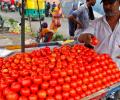
Tomato prices have been on the boil for more than a month. Data from major cities show that the spike has been between 125 and 150 per cent at the wholesale level. Soaring vegetable prices, including tomatoes, pushed the retail inflation rate to a nine-month high of 5.49 per cent in September, according to government data. Though reports say prices are expected to come down in the next few weeks after supplies improve from Madhya Pradesh and Himachal Pradesh, how long will the respite last is anybody's guess.

Finance Minister Nirmala Sitharaman on Saturday announced six new schemes and increased the subsidised Kisan Credit Card (KCC) loan limit to Rs 7 lakh from Rs 5 lakh, targeting everything from unemployment to crop productivity enhancement across the country. Presenting her eighth budget speech in Parliament, Sitharaman positioned agriculture as "the first engine of growth" and unveiled the Prime Minister Dhan-Dhaanya Krishi Yojana, a flagship program targeting 100 agri-districts grappling with low productivity, moderate crop intensity, and below-average credit parameters.
High delivery costs, caused primarily by a fragmented supply chain, bad logistics, together with poor standards are hurting India's horticulture exports much more than trade barriers, according to a World Bank report.
In a significant policy shift aimed at boosting agri-productivity and rural prosperity, Finance Minister Nirmala Sitharaman on Saturday announced six new agricultural schemes while increasing the subsidised Kisan Credit Card loan limit to Rs 5 lakh from the existing Rs 3 lakh, benefiting 7.7 crore farmers, fishermen, and dairy farmers.

In his address to the joint sitting of both Houses of Parliament at the start of the Budget Session, Kovind said the Rs 64,000 crore PM Ayushman Bharat Health Infrastructure Mission will prepare the country for a health crisis in the future.

India's first exposure to truly hi-tech protected farming of vegetables and other high-value horticultural produce came through the Indo-Israel project on greenhouse cultivation, initiated at the New Delhi-based Indian Agricultural Research Institute in 1998, shortly after the establishment of diplomatic ties with that country.

Retail prices of tomato had touched almost Rs 80 per kg in major cities owing to short supply and transportation cost over the past few weeks following heavy downpour.

However, the growth, driven largely by a bumper rabi harvest and facilitated by relaxation in lockdown, may not have resulted in a big rise in income for a section of farmers.
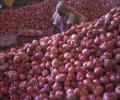
India's potato and tomato production could be marginally less in 2021-22 as compared to the previous year while onion output could be almost 17 per cent more than last year. This was stated in the first advance estimate of horticulture production released on Monday. The government also said total horticulture production is estimated to be at 333.3 million tonnes, a slight decrease of about 1.35 million tonnes (mt)?(or 0.4 per cent) over 2020-21.

Farmers shifted to other vegetables as they could not realise price in past 9 months

Machinery and manpower have been deployed, but stones falling from the hills are obstructing the road opening work, the officials said.

'Had they agreed to our demands that we raised two years ago, we would have never started our agitation again.'

The BJP launched an all-out and aggressive personalised campaign led by Prime Minister Narendra Modi himself, but voters went by local rather than national issues.

Normally, kharif sowing of vegetable seeds starts during the first week of May across the country. Farmers start preparing their fields to make them suitable for kharif sowing during the second fortnight of April. Now, however, faced with the lockdown, farmers are in a hurry to clear their fields of rabi crop and prepare for kharif planting. With a normal monsoon forecast this year, they are doing all they can to take advantage of pre-monsoon showers.

Government's objective is to bring down the cost of cultivation through efficient use of fertilisers and agro chemicals, and increase in realisation. It is, thus, planning to connect 200 agricultural mandis with electronic National Agricultural Mandis this year and 225 next year, to enable farmers to sell their produce hassle-free online.
President Ram Nath Kovind on Monday said the country's farm production and procurement increased during 2020-21 crop year despite the pandemic and agricultural exports reached a record level of Rs 3 lakh crore during the same period. In his address to the joint sitting of both Houses of Parliament at the start of the Budget session, Kovind said the government is focusing on making the country self-sufficient in edible oils besides making special efforts to promote organic farming, natural farming and crop diversification. "My government is working continuously to empower the farmers and the rural economy of the country... I would like to give maximum credit to the small farmers of the country for this consistent success and strengthening of the agriculture sector," he said.
Big Basket, Haldiram's & Amul among 101 cold chain projects okayed
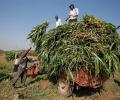
India achieved record foodgrains production this year but the withdrawal of three agri-reform laws and spike in cooking oil prices cast a shadow on the country's resilient agriculture sector that is on course for better harvest in 2022 despite pandemic blues. While soaring production of foodgrains that also helped the government provide free additional rations for COVID-hit poor families for many months together came as a relief, the passing year will be remembered for the long drawn farmers' protest at Delhi borders against the three laws and subsequent repeal of the legislations. The Indian agriculture sector, which was among the few segments that remained robust amid the pandemic gales, is expected to register a growth rate of 3.5 per cent in the current financial year ending March 2022.
8 out of 10 households are planning to cut their tomato consumption if prices stay in the Rs 75-150 kg range over the next three months.
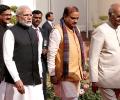
The President said that because of the policies of the government foreign investment has increased from $36 billion to $60 billion during the period.

'Aquaponics can effectively cushion the impact of a calamity like COVID.'

Amid the raging controversy regarding Uri Gowda and Nanje Gowda, the Vokkaliga chieftains who according to a section allegedly killed erstwhile Mysuru ruler Tipu Sultan, a prominent seer of the community on Monday urged putting an end to the issue, citing lack of historical evidence in this regard.

Sharad Pawar reckons that the NCP has value as a united, going concern, not as a gaggle of leaders in search of followers, notes Shreekant Sambrani.

Tomato prices in retail markets of metro cities have shot up to Rs 72 per kilogram on tight supply due to unseasonal rains in key producing states like Madhya Pradesh and Maharashtra.

The Union home ministry on Tuesday allowed opening of shops selling school books and electric fans, services of bedside attendants of senior citizens and public utilities including recharge facilities for prepaid mobile phones during the ongoing lockdown.

Young IIT engineers have come up with an affordable solution to the wastage of agricultural produce by developing a unique solar-powered cold storage system which works at almost zero running cost.
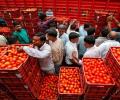
Among metro cities, tomatoes were sold at Rs 93 per kg in Kolkata, Rs 60 per kg in Chennai, Rs 59 per kg in Delhi and Rs 53 per kg in Chennai on Monday, data showed. The retail price of tomatoes was ruling at more than Rs 50 per kg in over 50 cities out of 175-odd cities tracked by the consumer affairs ministry.

A lesson we have not learnt from China is the urgent need to knit the vast country together to keep it from falling apart at the seams. While there is considerable dent in poverty, sadly, the North East remains as distant today as it always was, points out Shreekant Sambrani.
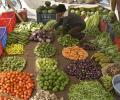
In most cases, however, retail consumers are paying higher prices in the absence of direct procurement from aggregator or farmers.
 © 2026 Rediff.com - Advertise with us - Disclaimer - Privacy Policy - Sitemap - Feedback - About us - Terms of use - Grievances